Chair Exercises for Seniors: A Gentle Starter List and Weekly Plan
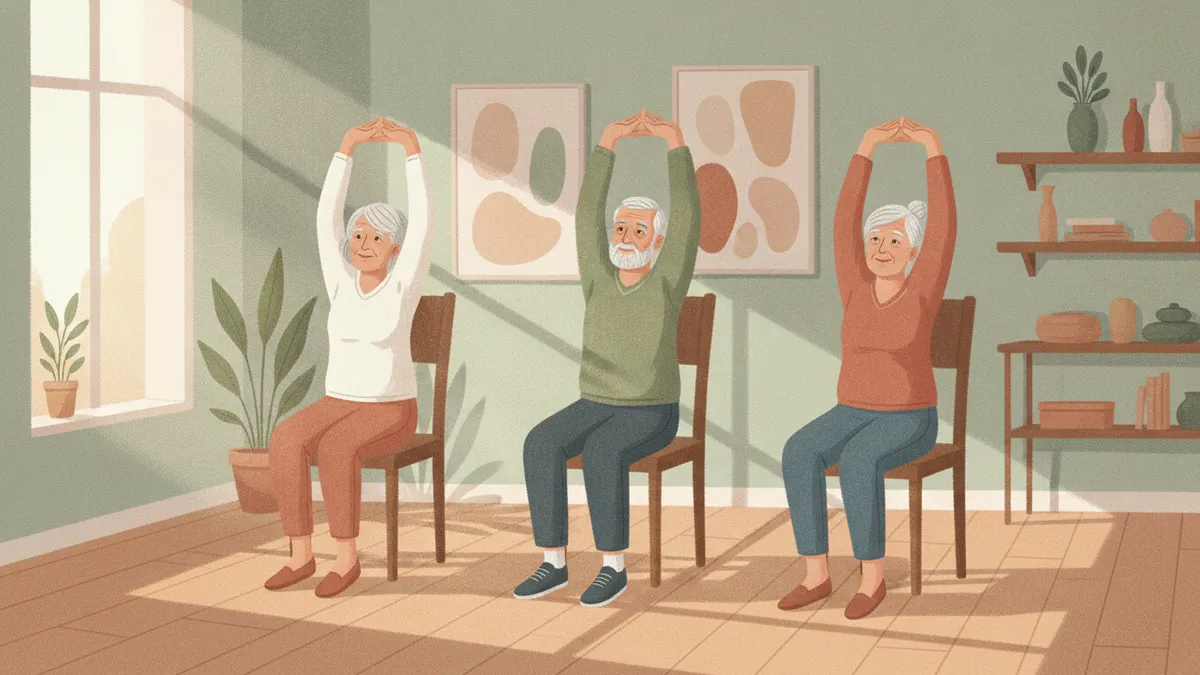
Chair exercises are the easiest way to begin moving again: you are supported, you set the pace and you can do them anywhere. For adults over 60, this is the sweet spot. You are not asking your knees to carry anything, you are not worried about balance, and you can stop and rest whenever you like.
Here is a practical starter list: what to include, how to put it together, and how to keep going once the first week is behind you.
What good chair exercises have in common
Not every list is equal. The most useful routines for older adults share a few traits.
- They are slow. Speed adds risk and takes away the benefit of noticing what you are doing.
- They cover the whole upper body and spine. Shoulders, arms, hands, neck and trunk.
- They keep breathing easy. If you cannot talk comfortably, slow down.
- They are short. Ten to fifteen minutes is enough to feel done and to want to come back.
- They are repeatable. A familiar sequence beats a new workout every day.
A starter list in six groups
Warm-up: wake up the joints (2 to 3 minutes)
- Ankle pumps: lift your toes, then your heels, five times each.
- Wrist and finger circles: open and close your hands, circle the wrists slowly.
- Shoulder rolls: roll backward five times, then forward five times.
- Neck turns: look gently to one side, center, then the other. Keep the chin level.
Arms and shoulders
- Arm raises: lift both arms forward to shoulder height, lower slowly. Eight repeats.
- Side reaches: raise one arm overhead and lean a little the opposite way, then switch.
- Elbow circles: fingertips on shoulders, draw slow circles with the elbows.
Spine and trunk
- Seated twist: hold the chair sides or rest hands on thighs, turn gently to one side and then the other, leading with the eyes.
- Cat and cow, seated: hands on knees, round the back as you exhale, lengthen as you inhale.
- Side bend: slide one hand toward the floor along the side of the chair, return, switch.
Legs, gently
- Seated marching: lift one knee a few inches, lower, alternate. Keep it small.
- Leg extensions: straighten one knee until the leg is level, hold a breath, lower. Repeat on each side.
- Heel slides: slide one heel forward along the floor and back.
Slow flow: tai chi arcs
This is where seated tai chi shines. Rather than counting repetitions, you link soft arcs of the arms with your breath: raise the ball, part the hands, wave hands like clouds. The rhythm is unhurried and meditative, which many people find easier to enjoy than a numbered workout.
Cool-down
- Long exhale breathing: inhale for four, exhale for six, five times.
- Hands on the lap: a minute of stillness.
A simple weekly plan
You can build a gentle week with this structure.
| Day | Focus | Time |
|---|---|---|
| Monday | Warm-up, arms and shoulders, cool-down | 10 minutes |
| Tuesday | Slow flow (tai chi arcs) | 10 minutes |
| Wednesday | Spine and trunk, legs | 10 minutes |
| Thursday | Rest or a walk | |
| Friday | Slow flow and arms | 12 minutes |
| Saturday | Everything lightly, your favorite parts | 15 minutes |
| Sunday | Rest |
Adjust as you wish. The point is regularity, not perfection.
How to start if you have not exercised in a while
Begin with five minutes for the first three days. Use small movements and stop before you feel tired. Add a minute or two every few days. The goal in week one is to prove to yourself that you can do it, so choose a size that feels almost too easy.
Safety essentials
- Use a stable chair, no wheels, flat seat.
- Wear non-slip footwear.
- Breathe out on effort, never hold your breath.
- Stop with sharp pain, dizziness or chest discomfort, and contact a medical professional.
- Talk to your doctor before starting if you have a health condition or you have been inactive for a long period.
Why add tai chi to a chair routine
A list of exercises can feel mechanical. Tai chi gives the same gentle movement a flow and a purpose. Because the practice is about slowness and awareness, it is easy to do without strain, and it tends to leave people feeling calm rather than drained.
Flowsit chair tai chi plan is built around this idea. You take a short quiz and get a personalized 28-day chair tai chi plan. Each day brings a seated session of about 10 to 15 minutes with the movements guided step by step and a timer. Progress and daily streak are tracked, so the plan keeps you coming back instead of leaving you to invent a routine every morning.
Making it stick
Same time, same place. Anchor the session to a daily event, like after breakfast.
Make it pleasant. Soft music, natural light, a favorite chair.
Track it. A paper calendar or an app streak makes progress visible.
Forgive misses. If you skip a day, simply do tomorrow's session. Consistency is a pattern, not a streak you must never break.
Celebrate small signs. Opening a jar a little more easily, standing up with less fuss, or feeling a little brighter in the afternoon are the quiet wins worth noticing.
What this is and is not
Chair exercises are gentle movement for a more active day. They are not a replacement for medical advice or treatment, and results vary from person to person. Think of them as a kind, low-pressure way to build a habit that supports how you want to feel.
Examples of how people use a list like this
The morning anchor. After breakfast, someone sets the chair by the window and runs through the warm-up, arms and spine groups in ten minutes. The routine marks the start of the day, the way a morning walk does for others.
The rainy-day plan. On days when walking outside is not appealing, a chair routine keeps the habit alive without any extra preparation. Nothing to put on, nowhere to go.
The shared session. Two friends or a couple sit side by side and follow the same sequence. Shared routines are easier to keep, because each person quietly expects the other to show up.
The evening wind-down. A slow flow of tai chi arcs before dinner or before the news is a calming way to close the afternoon.
How to tell whether a routine suits you
After a week, ask three questions. Did I look forward to it, or at least not dread it? Did I finish feeling the same or better than when I started? Could I imagine doing it again tomorrow? If the answer to all three is yes, keep going. If not, swap one section, lower the pace or shorten the time until it fits.
Next
If you only have a short window, try the 10-minute chair routine. To compare styles, read chair yoga versus chair tai chi. For the flow-based approach, start with chair tai chi for seniors.