10-Minute Chair Exercises for Seniors: A Daily Routine You Can Repeat
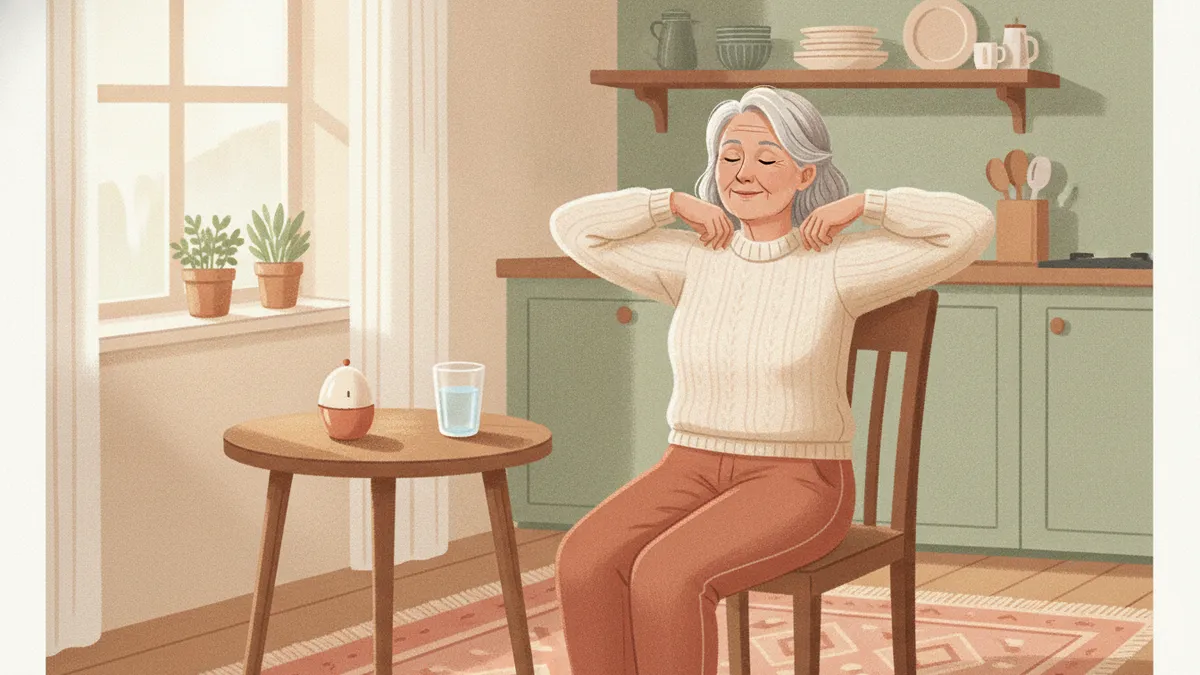
Ten minutes is the magic number for a daily chair routine: short enough to begin without negotiating with yourself, long enough to feel you did something. If you have been waiting for a spare hour to begin exercising, the good news is that you do not need one.
Below is a complete ten-minute sequence you can follow today, with timing for each part, a way to adapt it, and ideas to keep it going for the long run.
Why ten minutes works
Most people do not quit because the routine is too gentle. They quit because it is too big. Ten minutes fits into the cracks of a day. You can do it before the kettle boils twice, between breakfast and the first call, or just after the news.
There is also a psychological reason: when the goal is small, the starting resistance is small. You sit down, you begin, and you often find you want to keep going.
What you need
- A sturdy chair with no wheels and a flat seat
- A non-slip floor and comfortable shoes or grippy socks
- Space for your arms to open to the sides
- A timer, a clock or a guided session
- A glass of water
The 10-minute routine
Minutes 0 to 1: arrive
Sit forward on the chair, spine tall, feet flat, hands on thighs. Breathe in through the nose for a slow count of four, out for six. Do five rounds. Let your shoulders drop with each exhale.
Minutes 1 to 3: loosen the joints
- Wrist circles: five in each direction.
- Finger waves: open and close your hands slowly, ten times.
- Shoulder rolls: five backward, five forward.
- Neck turns: slowly look to the right, back to center, then left. Three rounds.
- Ankle circles: lift each foot slightly and circle the ankle, five each way.
Minutes 3 to 6: slow arm flow
This is the heart of the session and borrows from tai chi.
- Raise the ball (4 times): hands low in front, palms up, rise to chest height, then sink down with palms turning toward the floor.
- Part the curtains (4 times each side): one hand rises, the other presses down, chest turning slightly.
- Wave hands like clouds (8 slow cycles): alternate arcs of the hands in front of the body.
Keep your breath slow and your movements smooth.
Minutes 6 to 8: spine and sides
- Seated twist: turn gently to the right, hold for two breaths, return, then left. Three rounds.
- Side reach: raise the right arm overhead and lean a little to the left. Switch. Three rounds each side.
- Cat and cow: hands on knees, round the back on the exhale, lengthen on the inhale. Five rounds.
Minutes 8 to 9: legs awake
- Seated marching: lift one knee a few inches at a time, alternating, 16 steps.
- Leg extensions: straighten one knee, hold a breath, lower. Five each side.
Minutes 9 to 10: settle
Hands on lap. Breathe in for four, out for six, five times. Close your eyes if that feels comfortable. When you open them, sit for a few seconds before standing.
Make it easier or harder
Easier:
- Shrink the range of movement.
- Cut each set in half.
- Skip the leg section on tired days.
- Do the routine in two five-minute blocks.
A little more challenge:
- Add a few more repeats.
- Slow the movements even more; slowness is its own challenge.
- Add a second flow section instead of the legs.
Timing with a guided session
Counting minutes yourself can interrupt the calm. A guided session with a timer takes care of it. Flowsit chair tai chi plan offers exactly that with chair tai chi: a short quiz builds a personalized 28-day plan, and each day opens a seated session of about 10 to 15 minutes. Movements are guided step by step, a timer shows the time left, and your progress and daily streak are saved. You simply sit down and follow along.
What most people notice first
In the first week, expect modest signs: shoulders that feel a little looser by the end, a calmer breath, a small sense of accomplishment. That last one matters more than it seems. Doing something good for yourself at the start of the day tends to shape the rest of it.
Habit tips
Use an anchor. Choose something you already do every day and attach the routine to it.
Prepare the space. Leave the chair where it is easy to sit and the room tidy.
Pick the same time. Your body learns the cue.
Make it a small treat. A favorite tea afterward, a bit of music, a sunny spot.
Track it. Cross off days on a calendar or let an app count your streak.
Be kind about misses. If you skip a day, do ten minutes tomorrow. No catching up.
Safety notes
- Move slowly and within a comfortable range.
- Do not hold your breath.
- Stop if you feel pain, dizziness or chest discomfort, and seek medical advice.
- Talk to your doctor before starting if you have a health condition, recent surgery or have been inactive for a long time.
- Stand up slowly after the session.
This routine is gentle movement for well-being. It is not a treatment, and it does not promise to change a medical condition.
Variations for different days
Stiff morning: emphasize the loosening section and keep the arcs small.
Low-energy afternoon: do the arm flow and the twists, skip the legs.
Restless evening: do the arm flow slowly twice and finish with a long breathing session.
Feeling great: repeat the flow section and enjoy it.
Next
For a bigger list of seated options, see chair exercises for seniors. To go from one routine to a month of them, take a look at the 28-day chair workout. And for the flowing arm work in more detail, read the guide to chair tai chi.